I Gave My AI Agent $1,000 - Whats the worst that could happen?
Milo started its life in 2021 as a simple chatbot that allowed me to access my Obsidian Notebook via the Telegram Messaging Platform. At the time it was simple and worked well, but over the past several years, Milo has evolved to the point where it not only superseded Obsidian but has essentially become its own standalone agentic operating system. I built a powerful automation framework into Milo and an extension system to allow me to extend the functionality of Milo. So I decided to do the sane thing - create a stock market trading system powered by Milo and give it $1,000 of my own cash; what's the worst that could happen?
The stock trading platform Robinhood did something a bit crazy: they released a version of their stock trading platform built for autonomous AI Agents to buy and sell stock. This was built with tools such as Claude, ChatGPT, and OpenClaw to use to automate stock trading. The best part of Robinhood's implementation of their Agentic Trading Platform is they built it on top of the widely popular MCP standard. My custom personal assistant, Milo also fully supports the ability to interact with remote MCPs so it only made sense for me to connect the two.
The Harness / Agent Loop / Models
Milo's core can act as both the harness and agent loop for any MCP that it connects to; however, in this case, I felt it was best to build out a custom MCP Harness and Agent Loop. This will allow the Milo Trading System to run independently of the main Milo system while still being able to leverage the core Milo automation tools. This solves one of the biggest problems with using the default Milo core: it is heavily influenced by me. I want the Milo Trading System to act independently; it also implements a "separation of powers" mindset, which limits the ability to make buy/sell trades on the platform to the dedicated Milo Trading Harness and does not expose it to the base Milo core.
The Milo Trading Agent Loop is built on the same advanced reasoning loop that the core Milo platform is built on; however, it is gated away from most of my personal notes that Milo has access to. Milo has over 20 years of my notes, so giving the Milo Trading Agent access to that serves no useful purpose and will just consume countless tokens due to the massive context overhead. The other difference with the Milo Agent Trading loop is the number and type of tools that it has access to. The core Milo platform has access to over 400 tools in its tool registry, and the Milo Trading Agent Loop has approximately 80.
Finally, one of my favorite features that I built into Milo is the Model Factory; this is a pseudo-way to fine-tune and train a model for a specific task that can be used anywhere in the Milo Platform. This is done by giving it access to its own notes, features, and a self-contained MiniRAG. This not only allows this specialized model to be provided access to some basic trading strategies and goals, but it also allows it to reflect on its decisions and reinforce the model based on its choices - its ok for Milo Trader to make mistakes as long as it learns from them.
Infrastructure and Tools
The amount of compute to power the Milo Trading Platform is pretty crazy. The core Milo instance is hosted on a cloud instance with a major web hosting provider. The core uses around 36 GB of RAM to operate and has 8 Intel Xeon CPU cores. Keep in mind that this is shared with 12 instances of Milo; however, my instance consumes around 12 GB of RAM most of the time.
One of the nice features of Milo is the ability to securely connect it to other machines at home over my private ZeroTier network to offload compute tasks. In my case, I have given Milo access to my Nvidia DGX Spark and a M4 Mac Mini with 24 GB of Unified RAM.
The Primary LLM that powers the Milo Trading Bot runs on the Nvidia DGX Spark and a secondary Gemma4-based model runs on the Mac Mini. The other purpose of the Mac Mini is it gives the platform access to a Chrome Web Browser. Milo's Trading Agent uses the Mac Mini's web browser and secondary model to perform research on stock tickers, companies, market conditions, world news, current events, and other factors that can influence stock prices. This research loop is fed back into the main Milo Trader MiniRAG.
The DGX Spark also runs a reflection loop that gives the primary Milo core system insight into how the trading system is running - think of it as a supervisor conducting a performance review on an employee. Milo also uses this reflection system to build and manage its own stock market strategies.
The Risks
When I built this system, I intentionally built it in a way that I had limited influence on this system. I know myself too well and would be tempted to meddle with Milo instead of trusting the system I have been building for several years. There are only 2 controls I have with the Milo Trading System
1) I can turn it off - again this is my money, so I do have a kill-switch. 2) I can blacklist stocks that may be seen as conflicts of interest - I do work with several large publicly traded companies, so there is always a risk that I may be exposed to information that has not been made public, and I do not ever want to be accused of insider trading, so I do have a way to add these companies to the list.
That's it; I have no way to force Milo to buy or sell anything - its a huge risk, but I am going to put my trust in the system.
Current Progress
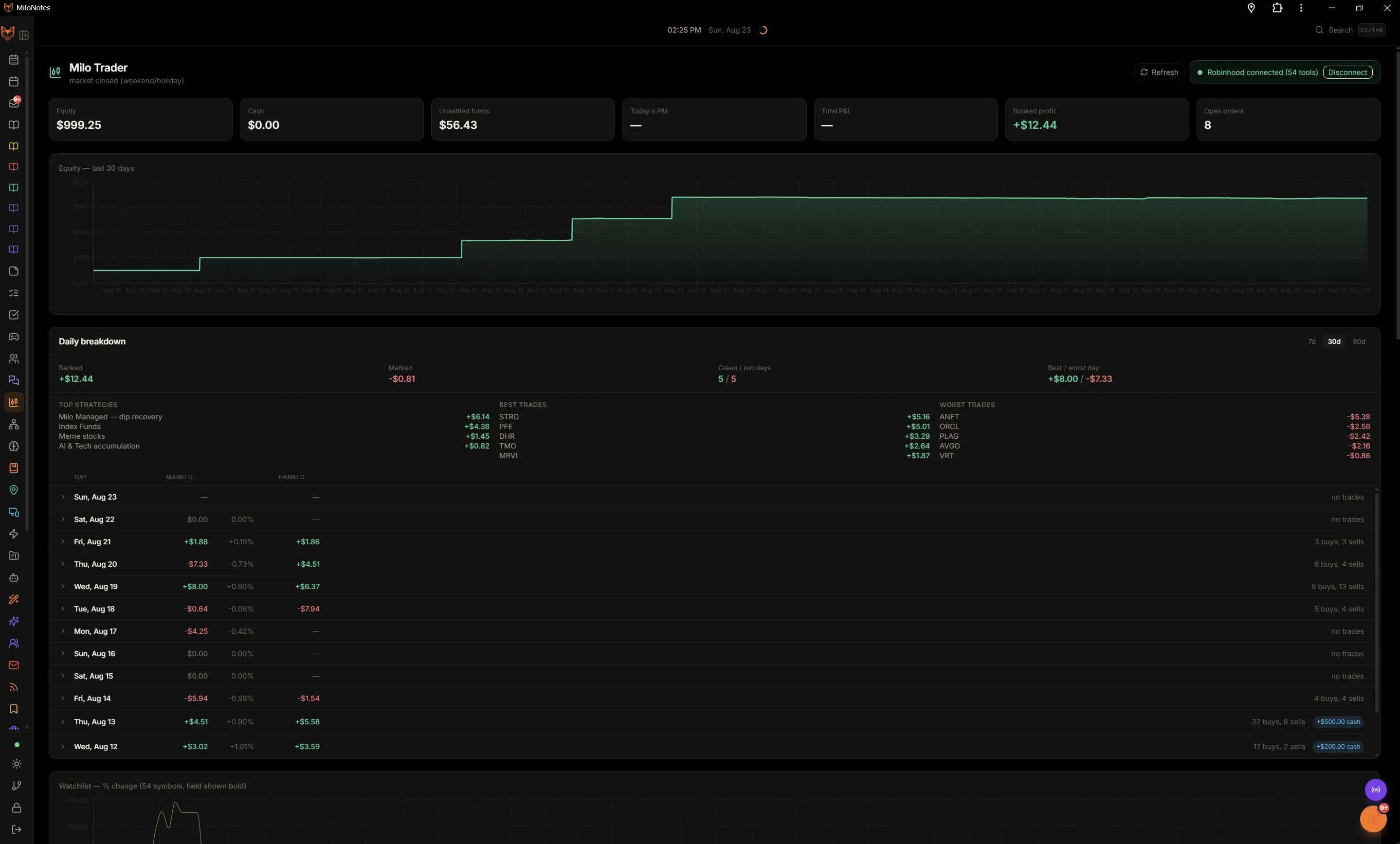
The system works; everything has been running since August 12th when I first tested it with $150. I have since bumped it to $1,000. During this time, Milo has made close to 38 buys and 24 sells. Milo has had several good days and a few bad days. Currently Milo has lost only 75 cents out of the initial $1,000 investment, but it has learned a surprisingly large amount of information with those losses, and I do expect it to start generating a profit soon. On its worst day, Milo lost $12.00, but it quickly rebounded.
In the case of Milo, I fully expected it to lose money and have some good days and bad days - this is needed to allow the system to build and understand its own strategies. This is very much the same with humans as we (hopefully) learn from our mistakes.
I will post a few follow-ups with the progress over the next few months to see if I made a great decision or lost my mind.